

Prior Authorization and Eligibility Verification in One Workflow
Prior authorization and eligibility verification are separate pre-service checks that can share one workflow. Eligibility and benefits verification confirms what the health plan reports about coverage and benefits for the planned date of service. Prior authorization is the payer’s advance review of a specific request when the plan requires it.
Consider an outpatient imaging visit. Two days before the appointment, the scheduler learns that the patient’s insurance has changed. The front desk checked the original plan at scheduling, and the authorization coordinator worked from that plan. A shared record helps staff confirm the new benefits, check whether the new plan requires authorization, and tell the ordering team and patient what to expect.
Table of Contents
Why front-end errors carry into billing
A wrong member ID, an unresolved primary payer, or an authorization that lists a different procedure can create rework before or after a visit. If a claim fails a submission edit, the billing team may have to correct and resubmit it. If the payer processes the claim and denies it, the team has to review the determination and choose the appropriate next step. An accepted submission can still result in a denial. CMS Medicare Claims Processing Manual, chapter 1
Authorization delays also affect access to care. In the AMA’s 2025 survey of 1,000 practicing physicians, 95% said prior authorization delayed access to needed care. Twenty-six percent reported a serious adverse event for a patient that they associated with prior authorization. American Medical Association survey findings
Earlier verification can give staff time to investigate discrepancies and improve the information they use for patient estimates. Any patient balance still depends on the payer’s determination and applicable plan, contract, and billing rules. CMS guidance for providers on surprise billing protections
What patient eligibility and benefits verification should cover
Confirm coverage for the planned service
Start with the exact plan product, member information, and expected date of service. Where relevant to the visit or procedure, confirm and document the following.
- Coverage dates and whether the payer reports active coverage for the planned date.
- Service-specific benefits and the network status of the rendering provider and facility.
- Applicable copay, coinsurance, and deductible information for the plan’s benefit period.
- Benefit exclusions and limits, including available visits or units when applicable and obtainable.
- Coordination of benefits (COB) and which plan should be billed first when the patient has more than one plan.
Record when and how each detail was verified. If a portal or electronic response leaves a relevant benefit unclear, confirm it with the payer before relying on it for scheduling or a patient estimate. An active coverage response and a benefit estimate are inputs to the workflow. Final payment is determined under the applicable plan and claim rules. CMS Medicare eligibility transaction companion guide
Set a pre-service recheck policy
Check eligibility at scheduling when practical. Set a second checkpoint before service for cases with a higher chance of change or a greater administrative impact. For example, a practice might recheck certain scheduled procedures 48–72 hours in advance. That window is an internal workflow choice. Adjust it for payer rules, booking lead time, and appointment urgency. Recheck when the patient reports a new plan or when a change in date, site, or service could affect earlier findings.
How the healthcare prior authorization process works
Confirm the requirement and assemble the request
Check whether the patient’s exact plan requires authorization for the ordered service. Confirm the applicable CPT or HCPCS procedure code, rendering provider, facility, and site of care as relevant. Record the source and date of the requirement check. If the plan delegates review to a utilization management organization, route the request to the designated reviewer.
Use the applicable policy to determine which records the request needs. That may include the order, relevant visit notes, test results, or documentation of prior treatment where the criteria call for it. Assign one person to confirm submission and track requests for additional information. A portal status such as “pending” is most useful when it comes with a case number, an owner, and a follow-up date. UnitedHealthcare provider administrative guide
Plan around payer decision timelines
Beginning in 2026, CMS-0057-F generally requires covered Medicare Advantage organizations and applicable Medicaid and Children’s Health Insurance Program (CHIP) payers to issue decisions within 72 hours of receipt for expedited requests and within seven calendar days for standard requests involving medical items and services subject to the rule. Payers must act sooner when the patient’s condition requires it, and program-specific rules can affect the deadline.
The rule’s decision timeframes exclude drugs and do not apply to Qualified Health Plan issuers on Federally-facilitated Exchanges. Check the applicable plan and program before using any deadline to schedule care. CMS prior authorization process FAQ
Set the practice’s submission date early enough to allow for documentation collection, payer review, and follow-up. For an urgent case, have the ordering team assess the appropriate clinical pathway and whether the payer’s expedited process applies. For an example of working with a delegated reviewer, see the MediBilliX EviCore prior authorization guide.
5 steps for prior authorization and eligibility verification
Use one case record or linked work queues with a named owner and a due date for each open action. The record should make it possible for another staff member to pick up the case and see what happened, who needs to respond, and when.
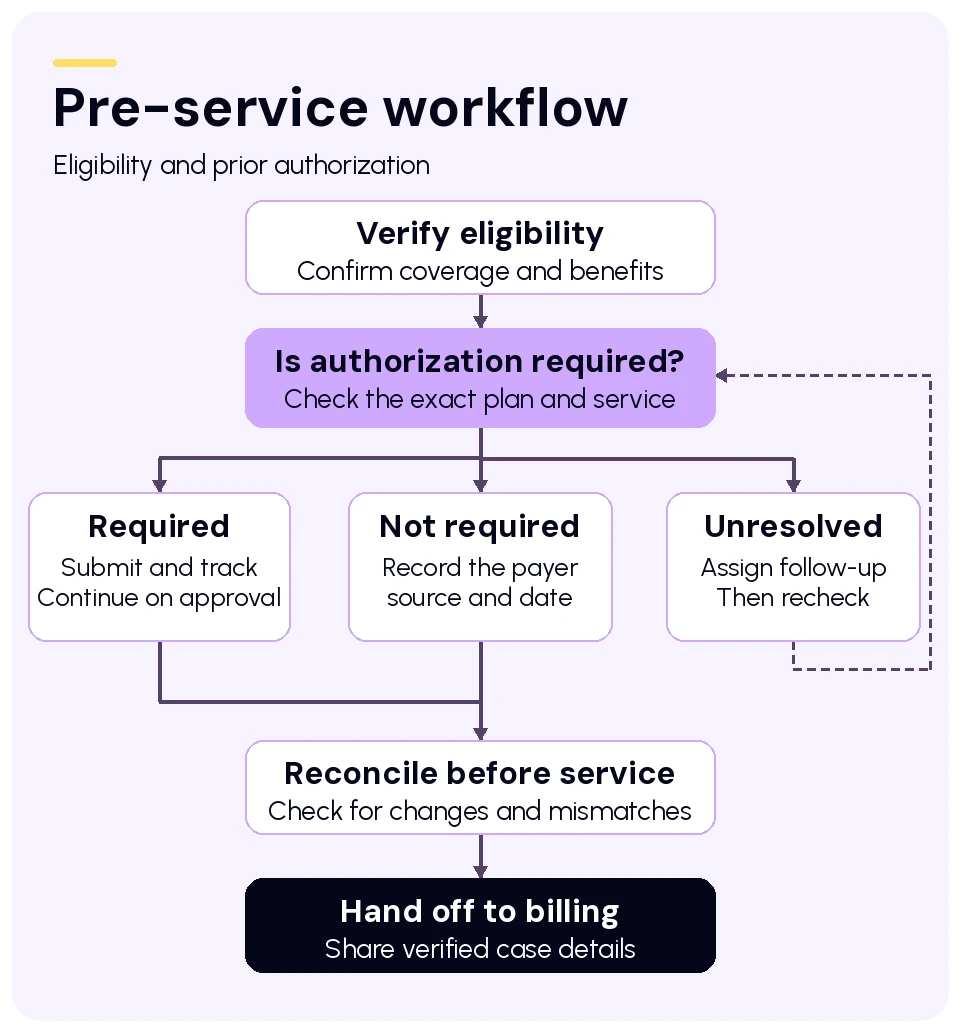
| Workflow stage | What the team records or does |
|---|---|
| 1. Intake and eligibility | Capture the order, plan product, member ID, date of service, and rendering provider or location. Verify active coverage and relevant benefits. Assign missing or conflicting information for follow-up. |
| 2. Authorization requirement | Check the payer or designated reviewer. Record “required,” “not required,” or “unresolved,” along with the source and date. Move a confirmed “not required” case to pre-service review. Assign unresolved cases for investigation. |
| 3. Request and follow-up | If required, submit the applicable clinical records and retain the submission confirmation. Track the case ID, determination, deadlines, and next action. Notify scheduling and the ordering team when a pending or adverse determination affects the care plan. |
| 4. Pre-service reconciliation | Recheck coverage as indicated. Match the approval with the planned service, provider or facility, dates, and authorized visits or units where relevant. If the plan or service changed, confirm whether the existing authorization still applies. |
| 5. Billing handoff | Send the verified payer information and any applicable authorization reference to billing. Match claim details to the service performed and relevant approval before submission. Review payer acknowledgments and remittances for recurring issues. |
For example, if an imaging order changes to a study with contrast, the team should confirm that the procedure on the order, appointment, and authorization still matches. If the approval needs updating, assign that step and let scheduling know before the visit.
Four steps to improve the front-end revenue cycle
1. Use X12 270/271 eligibility transactions where available
The ASC X12N 270 is an electronic eligibility and benefit inquiry. The 271 is the corresponding response. Practices can send inquiries through compatible practice management systems, EHR integrations, or clearinghouses. Where real-time inquiry is available, it can help staff check routine coverage and benefits without repeating the same manual lookup. Route incomplete or ambiguous responses to a staff member, and use the appropriate payer source to confirm service-specific authorization requirements. CMS health plan eligibility transaction standard
2. Standardize documentation for high-volume services
Build short checklists by service and payer for the requests your team handles most often. List the required records, who supplies each one, and where staff can find the current policy. When a payer asks for more information, record the exact request and who is responsible for responding.
3. Set alerts around case deadlines and service dates
Use alerts for open authorizations and unresolved eligibility issues. A 72-hour reminder can be a useful internal checkpoint for some scheduled cases. Set earlier alerts when the service or plan requires longer lead time. Include the missing item, the next action, and the owner so the alert prompts a decision.
4. Use automation or dedicated support for repeatable work
Use automation where your systems can reliably run routine inquiries or surface aging cases. Assign exceptions to staff who can interpret the response, verify the current rule, and escalate when needed. If volume regularly exceeds capacity, consider dedicated verification or authorization support. Start by tracking appointments delayed for unresolved eligibility or authorization and claims denied for related reasons. Compare the same definitions across periods so you can see where rework persists.
Frequently asked questions
What is the difference between prior authorization and eligibility verification?
Eligibility verification checks the patient’s insurance status and reported benefits for a planned date of service. Prior authorization is the payer’s advance review of a specific service, when required. A practice may need both checks for the same encounter.
Does prior authorization guarantee payment?
Payment still depends on coverage on the date of service, the service actually delivered, and the applicable plan and claim rules. If a patient changes plans before the visit, confirm whether the new plan requires its own authorization. UnitedHealthcare provider administrative guide
Why do healthcare claims get denied due to eligibility and prior authorization?
Potential causes include inactive coverage on the service date, billing the wrong payer first, a missing required authorization, or a mismatch between the billed service and the approval. Use the payer’s determination and remittance details to identify what needs correction or follow-up.
How far in advance should patient eligibility and prior authorization be verified?
Verify eligibility at scheduling when practical, then recheck according to practice policy and changes to the case. A 48–72-hour recheck is one option for selected scheduled services. Confirm authorization requirements as soon as the plan and ordered service are known, and allow time for documentation, the applicable payer review window, and follow-up.
What is an EDI 270/271 transaction in medical billing?
A 270 is an electronic inquiry about health plan eligibility and benefits. A 271 is the response, which may include coverage status and reported benefit or cost-sharing information. If the response leaves a service-specific detail unclear, confirm it with the payer.
How does integrating eligibility checks with prior authorization reduce denials?
A shared workflow gives staff an early checkpoint to verify plan-specific requirements, assign a required authorization, and reconcile the approval with the scheduled service. This can help catch missing or mismatched information before billing, reducing the risk of related denials.
Start with the handoff between scheduling and authorization
Pick one high-volume service and review what happens from scheduling through claim submission. Check where the team records coverage, who confirms authorization requirements, and how changes reach scheduling and billing. That review can show where a case is most likely to lose an owner or move forward with incomplete information.
MediBilliX Healthcare LLC supports U.S. practices and specialty groups with eligibility and benefits verification and prior authorization management. Discuss your prior authorization and eligibility verification workflow with MediBilliX.



2 Responses